
by: Kevin Loux, Chief Impact Officer, Charlotte Works & Raquel Lynch, Chief Program Officer, Goodwill Industries of the Southern Piedmont
With over 4 million Americans quitting their job in August, September, and November 2021, the “Great Resignation” is no longer a pandemic trend, but a paradigm shift in the workforce. Many employers lament this talent shortage as a signal that no one wants to work. The narrative to date has focused on unemployment benefits and has portrayed this issue as a matter of “lazy and entitled” workers. Similarly, as most people would not drive twice as far to pay twice as much for the same product, the behavior of today’s workers is not caused by laziness but by rational decision-making. While employers are used to having more leverage than they do today, the reality is that the same market forces that drive the success of a business’s product or service are now impacting their ability to secure talent.
Many businesses are familiar with the impacts of economic globalization through e-commerce but are now seeing these same forces impact their workforce. With the increased availability of remote work, the demand for job seekers is not limited to a specific geography, which means employers have more competition than ever before. Just as e-commerce has benefited the most adaptable companies and put those that relied on only a geographic footprint out of business, the shift in the job market has the same power. Even companies without remote positions must consider that a job seeker with the skills to work remotely may do so, which reduces the supply of local talent. Just as consumers will not pay more for a worse product, job seekers will not take less pay for a lower-quality, less flexible job. This is also complicated because the labor market has a backward bending supply curve, which is a fancy way of saying that beyond a certain level of pay, most workers will value increased leisure time over increased revenue. This effect also extends to the quality of position in terms of flexibility and culture, where individuals may take pay cuts to move to companies that provide a better environment or lifestyle beyond a certain level of pay.
While this is an overly simplistic analysis, it is illustrative of today’s labor market. The reality is that the talent shortage doesn’t impact employers with quality jobs; it affects employers without quality positions. These could be employers that pay a low wage, have poor working conditions, a toxic company culture, or all the above. Many employers have been quick to increase wages but still cannot find talent as they overlook other elements of the equation. Workers have more options now, especially with the rising gig economy, and attracting and retaining talent is about more than just pay and location. Our recent talent survey of over 200 local individuals found that while wage was important, an opportunity for career advancement was even more critical.1 Even if you are fully staffed today, 58% of currently employed individuals we surveyed were actively looking to leave their job. Many see the talent shortage as an opportunity to shift to new markets, leaving behind lower-paying local jobs for higher-paying global careers. This means that even companies with talent may face high turnover if they have a poor working environment, low wages, or little opportunity for advancement.
What does this mean for employers struggling to attract or retain talent? While there is no quick fix, we can learn from history. In 1914, a time of labor unrest, Henry Ford announced he would pay $5 a day to his workers, double the industry standard. In 1926, he would go on to standardize the 40-hour workweek with no reduction in pay, slashing in half the industry standard of 80 hours a week or more. At the time, Ford said, “It is high time to rid ourselves of the notion that leisure for workmen is either ‘lost time’ or a class privilege.” Many were concerned about productivity declines, but when Ford saw productivity gains, eventually, the world followed suit. Adjusted for inflation and the current work schedule, that $5 a day in 1926 is equivalent to over $100,000 a year today. Of course, not every company is Ford; what about other employers? The federal minimum wage in 1968 was equivalent to $12 an hour in today’s economy, but that adjusted rate has been steadily declining since.
Additionally, if the minimum wage had kept pace with workers’ productivity, it would be over $26 an hour today. Like in 1926, now many are again questioning if we can also increase productivity by reducing working hours and raising wages. The four-day workweek is being slowly adopted worldwide by companies looking to attract talent, including Kickstarter. After adopting the four-day work week, Wanderlust has seen a 136% year-over-year growth in gross merchandise volume. Rethinking and reimagining pay and working schedules based on empirical evidence like Henry Ford did rather than just copying his practices of $5 a day and 40 hours a week is critical for employers to attract and retain talent today.
What about employers still struggling to hire after increasing pay and flexibility? Instead of competing in today’s red ocean of talent poaching, maybe it is time to find a blue ocean of talent. A recent study from Harvard found that there are 27 million latent workers nationally. This is a talent pool that wants to work more, but they are currently not able to. This includes part-time workers who want to go full-time, and workers who have been so discouraged they have stopped looking for work, even if they want to work. If they want to work or work more, why are these latent workers not applying? In the study, 84% found the application process too difficult, and many of these individuals had to submit between 20 to 40 job applications to get a single offer. Employers who are willing to rethink job descriptions, streamline their applicant tracking system, and remove excessive experience and background requirements will have a competitive advantage in attracting an untapped pool of talent. Removing unnecessary barriers also helps employers tap into the talent Charlotte Works and Goodwill work to upskill and prepare for careers.
Another key finding from our talent survey was that job seekers valued an opportunity for career advancement even more than a position’s salary. This underscores the importance of continually investing in employee training and development for talent attraction. While this is often cost-prohibitive for small and medium businesses, Charlotte Works and Goodwill have funding and services specifically designed to help companies with the training and development of workers. With quit rates at a recent high, how do you retain talent? The top reasons from our talent survey were flexibility, company culture, and workload balance. Embracing remote work when possible, looking at preventing burnout, and keeping workers safe are all critical parts of a multi-pronged talent retention strategy.
As an employer seeking commitment from job seekers, what are you willing to commit to providing in return for loyalty and productivity? We invite you to look at your talent development efforts and recruitment efforts, but most of all, look at your core values. Those lived values will drive job seekers to you and to stay. Money is an essential factor, but company culture and commitment to your workers are equally important. Before you renew your employee-focused efforts, take time to analyze the number of quality jobs you currently offer, consider assessing and updating your staffing plan, but most of all, don’t be a “lazy and entitled” employer in the eyes of job seekers.
One of our core values at Goodwill is build a village. We know success isn’t achieved alone, which is why we encourage partnership and collaboration to help our team and the people we serve in achieving their goals.
The Blumenthal Foundation has made an investment in our new Virtual Community, which will go live in early 2022. The pandemic highlighted the need for Goodwill to provide more equitable access to our services. Therefore, we are launching this new initiative to provide access to career building services and learning opportunities through an online platform.
The Blumenthal Foundation’s gift will support people throughout our 18-county region. Those who have previously not had access to services will be able to upskill, reskill or launch a career. They will also gain access to career coaches who can work with them on their goals and help align them with Goodwill’s job training and employment services.
Special thanks to the Blumenthal Foundation for believing in the vision that all people deserve to see possibilities, seize opportunities and prosper!
Another community partnership is helping students see possibilities, seize opportunities and prosper! Apparo and Goodwill Industries of the Southern Piedmont co-hosted a virtual Chief Officer event Thursday, September 30, to provide career advice and industry information to Goodwill participants! Goodwill University students enrolled in our Business Analyst/QA Tester training course had the opportunity to speak directly with Chief Officers from several IT organizations, building connections and gleaning insights into the IT industry along the way. The following IT professionals participated in the event:
- Shauna Latshaw – Compass Group
- Carlos Witherspoon – Compass Group
- Jim Clendenen – Kroger
- Ben Schwering – Premier
- Darrell Thompson – Coca Cola Consolidated
- Detlef Dohmen – Asahi Kasei
- Jeff Hughes – Brighthouse Financial
- Michael Hutchins – Rentokil
- Michael Laurenti – Food Lion
- Rick Doten – Centene
- Richard Donaldson – Duke Energy
- Shawn Cherry – AAA Carolinas
- Markus Hill – Rodgers Builders
“It’s exciting to see the chat box exploding with positive responses from the IT executives. It was a proud night for Apparo and Goodwill in partnership as we showcased the power of learning,” said Dr. Dana McDonald, vice president of Talent Development.
The Business Analyst/QA Tester training course prepares students to understand, analyze and enhance the quality of technological products and services. Students conduct hands-on exercises simulating real-world scenarios, working on two projects parallel in two leading methodologies in the current market. Goodwill’s Business Analyst/QA Tester training course is offered twice per year, with another cohort coming in Winter 2021. Like all of our training courses, this course is offered free of charge, thanks to the community’s donations and purchases. Learn more about this course, and all of our training courses.
Entrepreneurial skills are not only vital for business owners but will be critical for success in the workplace of the future. On August 25, representatives from Goodwill, Lowe’s and ASPIRE Community Capital gathered for a check presentation at the Goodwill Opportunity Campus to announce the expansion of entrepreneurial skills training programs offered at no cost for community members in the greater Charlotte area.
“We are so grateful to ASPIRE for giving Goodwill the opportunity to enhance our offerings on the Goodwill Opportunity Campus,” said LaRita Barber, chief advancement officer for Goodwill Industries of the Southern Piedmont. “Goodwill is committed to supporting individuals who want to enhance their skills and gain access to resources to pursue their personal and professional goals. This year, we began seeking a community partnership with a local organization to provide entrepreneurial education as part of our job training division, Goodwill University,” Barber added.
Thanks to a $275,000 grant provided by the Lowe’s Foundation, that vision is coming to life. ASPIRE and Goodwill are collaborating to provide ASPIRE’s suite of business development programs to Goodwill participants who need assistance with starting and growing successful small businesses, or gaining entrepreneurial skills. In addition to the new skills delivered through ASPIRE’s Community Business Academy and Business Accelerator Services, participants receive the wraparound supports Goodwill is known for including career coaching and navigation, basic needs support and more.
ASPIRE CEO Manuel Campbell echoed Barber’s sentiments adding, “Our focus is cultivating people through the power of partnership. We look forward to building strong and successful small businesses in our community, but we’re also looking at transforming lives, and we think that that’s the true impact of the work that we do at ASPIRE.”
Starting in September, two cohorts of participants will begin the Community Business Academy (CBA) 12-week course, which offers business training for entrepreneurs with emphasis on critical business fundamentals such as business planning, finance, marketing, problem-solving, and more. Small business practitioners and instructors teach the program.
“We’re going to include marketing, we’re going to include cash flow breakeven analysis, we’re going to create really fun and innovative ways for them to learn and apply game simulations, as well. That’s what differentiates our program from others,” said Tya Bolton, director of operations for ASPIRE Community Capital.
ASPIRE and Goodwill aim to provide avenues to prosperity for people in our region, through career services and entrepreneurship. While business ownership has long been an effective path to wealth creation, the skills and resources necessary to success haven’t historically been accessible for all people in our region. Participants in these programs find the support they need to start and grow their businesses.
Taylor Jackson, who owns POUR Mixology and Redd Rose Vodka, is a graduate of the Community Business Academy program. Jackson was already a business owner when she began with ASPIRE, but she struggled with her profits. With the help of ASPIRE, she was able to simplify the packages offered through her company and increase her profits.
“I was in and out of jobs prior to ASPIRE; just taking jobs here and there because I needed the money. Since taking their course, I have not had to go back to any job,” Jackson emphasized.
She hopes other aspiring entrepreneurs take advantage of the resources provided through this partnership. “If you’re on the fence because you think you don’t have time, or you don’t think you need it, take the course anyway. I learned things that I thought I knew, and my business benefitted from it,” she added.
In addition to the 12-week course and Business Accelerator Services, ASPIRE is also offering a micro loan fund, which focuses on providing access to capital to underserved entrepreneurs. “One of the key factors that we know is missing with respect to the success of small businesses in our community, is the lack of access to capital,” Campbell said. The loan, which ranges from $2,500 to $10,000 is available to all participants of this program.
Anyone interested in participating in the CBA course beginning in September, must participate in an information session with ASPIRE Community Capital. A list of upcoming information sessions can be found here.
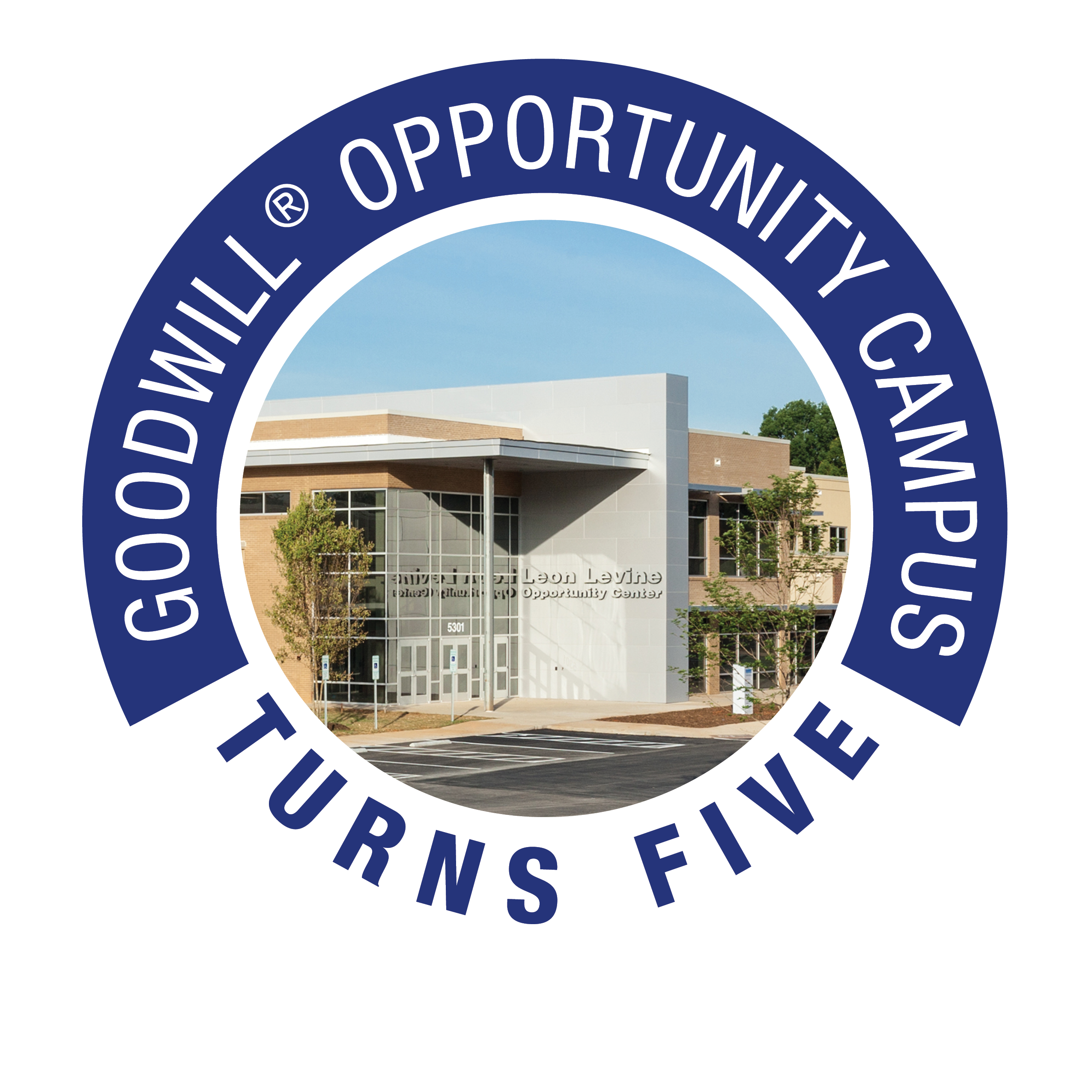
Celebrating Five Years at the Leon Levine Opportunity Center on the Goodwill Opportunity Campus
by LaRita Barber, Chief Advancement Officer
The audacity of hope is powerful thing. It took audacity to commit significant resources to a vision that would take years to be realized. But, that is exactly the courageous step that Goodwill Industries of the Southern Piedmont took as we embarked on the journey to build the Leon Levine Opportunity Center on the Goodwill Opportunity Campus. It took a village of committed team members, board members, donors and nonprofit partners to make the campus a reality.
As we pause to reflect on how far we have come since opening the doors on June 30, 2016 – the lessons learned, the lives transformed, the challenges faced and persevered, and the clarity of purpose crystalized – we are in awe of what a mustard seed of faith and hope can accomplish.
One might ask, what gave Goodwill the audacity to have such high hopes and bold ambition? What gave Goodwill the audacity to bet our future on a new way of providing services that was yet untested, that had no guarantees, and required more resources than we could supply on our own? What gave Goodwill the confidence to keep pressing forward when some state and federal legislation do not fully support our vision of opportunity and prosperity? When policies do not align with our participants’ goals to create prosperity, and the very supports that would provide stability are threatened or eliminated entirely?
What the audacity of hope has done is to embolden us to have the courage to see opportunities in our community to make a difference, to dream big, to take bold action, to take calculated risks and to have enough faith in our convictions and our mission to invest in people. While the Leon Levine Opportunity Center on the Goodwill Opportunity Campus is beautiful, it is the people that give it and us purpose. It is the people that give it a heartbeat.
Since 2016, so many people have experienced the campus. Individuals have come to take full advantage of a multitude of classes to upskill and seek better employment opportunities, meet with a coach or access technology on-site. People have visited the campus for their banking needs, to see a doctor or dentist, have a meal or cup of coffee, attend a meeting or event in our conference center, to volunteer, work in the urban garden, to shop and donate. This is exactly what we envisioned.
The campus is a source of light and hope. The work that the campus allows us to do gives us confidence to say that our work matters. It gives us a sense of pride to have others join us in this important work to partner with individuals to pursue their goals. What an honor to create a village of advocates to help propel people to a build a life that includes adequate resources to meet their basic needs, plan for the future, access meaningful career opportunities and contribute to their community. It is also a tremendous honor and responsibility to do this work.
What the audacity of hope has done is demonstrate to our community that all people matter, that justice and equity matter, and that we all share responsibility for creating a community where all can prosper. Without the audacity of hope, we would not have been able to navigate our way through the challenges of 2020. The racial and social unrest, and the pandemic, required us to hold tight to our belief in the audacity of hope to know that we had to be courageous to use our voice and do the work to shine a light on things that were not as they should be.
Since opening the Leon Levine Opportunity Center on the Goodwill Opportunity Campus five years ago, we have been blessed by so many individuals, nonprofit partners, foundations and corporations that began this journey with us, and so many others who have joined us along the way.
The $20 million investment to build the Leon Levine Opportunity Center on the Goodwill Opportunity Campus has allowed us to serve more than 45,000 individuals and create 150 new jobs at this one location. Our partners have supported so many in these five years, as well; Charlotte Community Health Clinic has been able to provide access to care for 25,000 patients and the Charlotte Metro Credit Union has created access for over 12,000 people to become banked.
The Leon Levine Opportunity Center on the Goodwill Opportunity Campus helps people see possibilities, seize opportunities and prosper. It is the realization of our audacity of hope.
In April, we recognize Second Chance Month, a time to raise awareness of the challenges facing people with justice-involved backgrounds and to spotlight the important work being done by community-based organizations to empower second chance individuals to achieve career and life success.
Did you know that more than 600,000 individuals are released from state and federal prisons every year in the United States? To prepare for successful reentry into their communities, they need tools and resources to overcome obstacles to employment, housing and social activities.
This is why Goodwill Industries of the Southern Piedmont partners with The Center for Community Transitions (CCT), an organization that helps justice-involved individuals and their families with employment and reentry services. We help to connect Goodwill participants with justice-involved backgrounds to CCT to take advantage of their specialized supports, and help to enroll CCT participants into job training programs at Goodwill. Together, we help to reduce recidivism by providing people with criminal records and their families tools and resources to rebuild their lives.
CCT’s LifeWorks! Program, focused on employment readiness, is based at the Goodwill Opportunity Campus, which helps foster the relationship between the two organizations and to provide a better experience for participants. Together, we offer individuals opportunities to engage in learning, skills development, work experience and holistic reintegration services.
Here at Goodwill, we know that the real work involves addressing the public policies and systemic practices that can contribute to a lack of access to opportunity. We seek to advance policy solutions that help people impacted by the justice system have a second chance for success and a fair chance for employment. Former offenders seeking jobs are only successful if companies are willing to look beyond their criminal record and implement proactive and well-informed employment practices. That’s why we advocate for second-chance employment and are proud to hire formerly incarcerated individuals.
By investing in community-based reentry programs, providing greater access to pre- and post-release education and training, promoting fair-chance hiring practices, removing barriers to employment and occupational licensing, and addressing the collateral consequences of conviction, second-chance individuals can change their lives through learning and the power of work!
We encourage you to read James Shepherd’s story. After spending four years in prison for a crime he didn’t commit, James finally had his conviction overturned and was looking to get his life back on track. He was able to enroll in Goodwill’s construction skills training program and launch into a new career!
For more than 30 years, the Blue Diamond Technology Awards have celebrated the best in technology innovation and talent in the greater Charlotte region. On October 6, the Charlotte Area Technology Collaborative (CATC) presented Goodwill Industries of the Southern Piedmont with the award for Human Capital – representing an individual or group who has made major contributions in the development of IT talent in the region.
“It is such an honor to have received a Blue Diamond Award and to be among all of the impressive finalists. We appreciate the recognition by industry leaders of Goodwill as a destination for technology training and talent,” said Dr. Dana McDonald, vice president of talent development for Goodwill Industries of the Southern Piedmont. “We especially thank the community we serve because these training programs are funded by donating and shopping in our stores. We also thank our large corporate donors who support these programs – the Cognizant U.S. Foundation, Google and Microsoft.”
At Goodwill, we know that skills-based trainings, like those offered through Goodwill University, can lead to long-term economic mobility for individuals, their families, and our community. That’s why for years, Goodwill has provided computer and employability skills training, including basic computer literacy for those living in the digital divide, and productivity tools courses for middle-skills jobs. In 2018, thanks to additional support from Grow with Google and the Cognizant U.S. Foundation, Goodwill expanded its digital skills trainings to provide new advanced courses to individuals who qualify, free of charge. Recent advanced IT offerings have focused on A+ certification/helpdesk support, cloud technology, code immersion, Salesforce and web development, to name a few.
Through our work with employers, we know there is a significant need in the Charlotte region for these professionals. The IT courses offered at Goodwill are helping people make themselves more marketable with valuable skills that coincide with in-demand careers in our area. In 2019 alone, 171 participants completed advanced IT training courses through Goodwill, earning an average starting salary of $18.21/hour.
In addition to no-cost training, Goodwill also provides its participants with:
- Access to technology to successfully complete the courses
- Case management, job placement support, and job retention assistance
- Paid vouchers for certification exams
- Free access to practice quizzes and online learning materials
- and resume building and interview prep support.
Do you know someone interested in increasing their technology skills, or advancing their career? Click here to view our current course offerings, or click here to learn more about our services and make an appointment with a career specialist.
Each September, we recognize the contributions of workforce development professionals who support job seekers and employers 
With this in mind, Goodwill was presented with two awards for its work in connecting graduates from its construction training programs at the Goodwill Construction Skills Training Center with local job opportunities. The programs Goodwill offers in the construction trades teach in-demand skills and prepare graduates with industry-recognized credentials to launch successful careers in this fast-growing industry.
Ben Hutchins, Pre-construction Project Manager with Holder-Edison Foard-Leeper, presented Goodwill with two awards on behalf of the joint venture. Holder Construction, Edison Foard, and R.J. Leeper have teamed up to manage and execute construction at Charlotte Douglas International Airport and for the Charlotte Convention Center renovation. The group presents recognition awards monthly to their outstanding community partners.
“[For] the good work that your team is doing on the Charlotte Convention Center construction project in providing us with resources and new hires. And equally, we would like to present on behalf of Holder-Edison Foard-Leeper to Goodwill for your excellent work in providing resources on the Charlotte Airport Terminal Lobby expansion project,” said Ben Hutchins.
Marvin Kelley, Director of Construction and Trade Training for Goodwill, received the awards and shared, “It’s great to see that the students have taken full advantage of all the things they’ve been provided – with coaching and preparation to be able to get a career in the construction industry.”
Thank you Holder-Edison Foard-Leeper for this honor!
New AHA Blood Pressure Kiosks Serve as Self-Management Tool for At-Risk Communities
Addressing Hypertension in Charlotte Will Save Lives
CHARLOTTE—April 27, 2019 – More than 240,000 people in Mecklenburg County have high blood pressure: 130 mm Hg Systolic (upper number) and 80 mm Hg Diastolic (lower number). The national average is even higher with an estimated 46 percent of U.S. adults falling into this life-threatening category, about 103 million people. High blood pressure is the leading cause of heart disease, stroke and kidney disease and can be linked to more than 400,000 U.S. deaths, each year. To address this growing number, the American Heart Association has teamed up with the Albemarle Foundation and CVS Health to place two blood pressure kiosks in Charlotte on May 17, 2019.
“The AHA brought us a way to make a big impact on the health of our community,” said Sandra Holub, Executive Director, Albemarle Foundation. “By being the first in the nation to donate a local self-monitoring blood pressure kiosk at Goodwill Opportunity Campus, our sponsorship to the AHA was matched by CVS Health which allowed Charlotte to receive a second kiosk that will be placed at Camino Community Health Center. Both locations serve at risk populations who are more likely to die of heart disease and stroke.”
The Albemarle Foundation was launched to power the giving potential of Albemarle Corporation employees. The Foundation supports employees as they work passionately each day to make a profound impact in their communities. To date, the Albemarle Foundation has granted over $34 million into the communities in which employees live and operate. The Foundation believes in the potential of every community to flourish and that by working together, they can make the communities even more prosperous, healthy and vibrant. Albemarle Corporation (NYSE: ALB), headquartered in Charlotte, NC, is a global specialty chemicals company that employs approximately 5,400 people and serves customers in approximately 100 countries.
The American Heart Association is committed to health equity and breaking down barriers that obstruct access to care and healthier environments. Today, 59 percent of African American men and 56 percent of African American women have high blood pressure, the highest among any race in the world. Uncontrolled high blood pressure has life-altering consequences, but increasing physical activity, managing weight, reducing the amount of sodium in your diet and eating more fruits and vegetables can prevent the onset or worsening of hypertension.
Hispanics are one of the largest and fastest-growing ethnic groups in the United States, currently estimated at 13 percent of the population in Charlotte Mecklenburg, and 17 percent of the Nation’s population, a number that is expected to reach 30 percent by 2050. According to the US Census, there are more than 137,000 Hispanics living in Mecklenburg County. Hispanics also experience a disproportionate burden of cardiovascular disease risk factors, including obesity, high blood pressure and type 2 diabetes.
The good news is that high blood pressure is manageable and there are tools available to raise awareness and reduce risk. Each blood pressure kiosk will include educational materials (English and Spanish) as well as a tracker to record your numbers and assess your risk. Health and wellness programs will be offered for staff and visitors at each location. A public service campaign from the American Heart Association to educate the community on high blood pressure and the risks associated with it will begin next month.
“Recently, the American Heart Association began to strategically focus on the public health priority zip codes with the greatest need in Charlotte. Through research, the AHA has learned that 44 percent of the people living in these six priority zip codes have high blood pressure compared to the 27 percent of residents living outside of these areas. Placing blood pressure kiosks at Goodwill Opportunity Campus and Camino Community Center, will help us address issues with access to care and healthier environments; while hopefully, unravelling what neighborhood and individual-factors can be improved to reduce hypertension, cardiovascular disease and mortality,” said Jennifer Phillips, Executive Director for the American Heart Association.
Ribbon cuttings for both locations will be held on May 17, 2019 and are open to the public. For more information on high blood pressure and other health risks leading to heart disease and stroke, please visit heart.org or contact your local American Heart Association.
###
The Charlotte Knights and Goodwill® are Spring Cleaning at BB&T Ballpark
The baseball club and local nonprofit will host an electronics recycling drive on March 26
WHAT: The Charlotte Knights are cleaning up BB&T Ballpark to get ready for spring, and are providing a large electronics donation to Goodwill Industries of the Southern Piedmont. Before the first game of spring between the UNC Charlotte 49ers and Clemson Tigers, Homer, the Charlotte Knight’s mascot, will help to load up a Goodwill truck with electronics from around the ballpark! The Knights and Goodwill invite community members and businesses to bring their electronics donations to the ballpark from 11 a.m. – 1 p.m. on March 26 to support Goodwill’s mission to help job seekers get career-ready and back to work in our community. Fans can also bring electronics to donate on their way into the game, including printers, laptops, tablets, e-readers, game systems, toys, cameras, accessories and more!
WHY: Spring is a great time to look through your home and workplace for items you don’t use or need – and donate them! Proceeds from community donations to Goodwill help to fund training programs in construction, customer service and IT, and career placement opportunities for job seekers here in our community. Have printers, computers, calculators, flat-screen TVs and other tech sitting around? Goodwill has an electronics recycling program that works to refurbish used technology and provide it for purchase at The GRID, its technology store located in the University area.
About Goodwill Industries of the Southern Piedmont
Goodwill has been serving individuals and families in the Southern Piedmont region of North and South Carolina for more than 50 years. Goodwill operates 25 retail stores and has more than 30 donation sites in the region. Proceeds from the sale of donated goods fund job training and employment services for individuals facing obstacles to employment such as lack of skills, experience or education, and those with criminal backgrounds. In 2017, Goodwill Industries of the Southern Piedmont provided employment services to more than 12,600 individuals thanks to donations and purchases from the community. For more information, visit www.goodwillsp.org.
Facebook.com/GoodwillSP | Twitter & Instagram: @GoodwillSP | LinkedIn: Goodwill Industries of the Southern Piedmont
Media Contacts
Samantha Story | Public Relations & Communications Manager | Goodwill Industries of the Southern Piedmont | Direct: (704) 332-0262 | Email: sam.story@goodwillsp.org
Melinda Wilshire | Director, Marketing & Communications | Goodwill Industries of the Southern Piedmont | Direct: (704) 916-1616 | Cell: (443) 540-0593 | Email: melinda.wilshire@goodwillsp.org