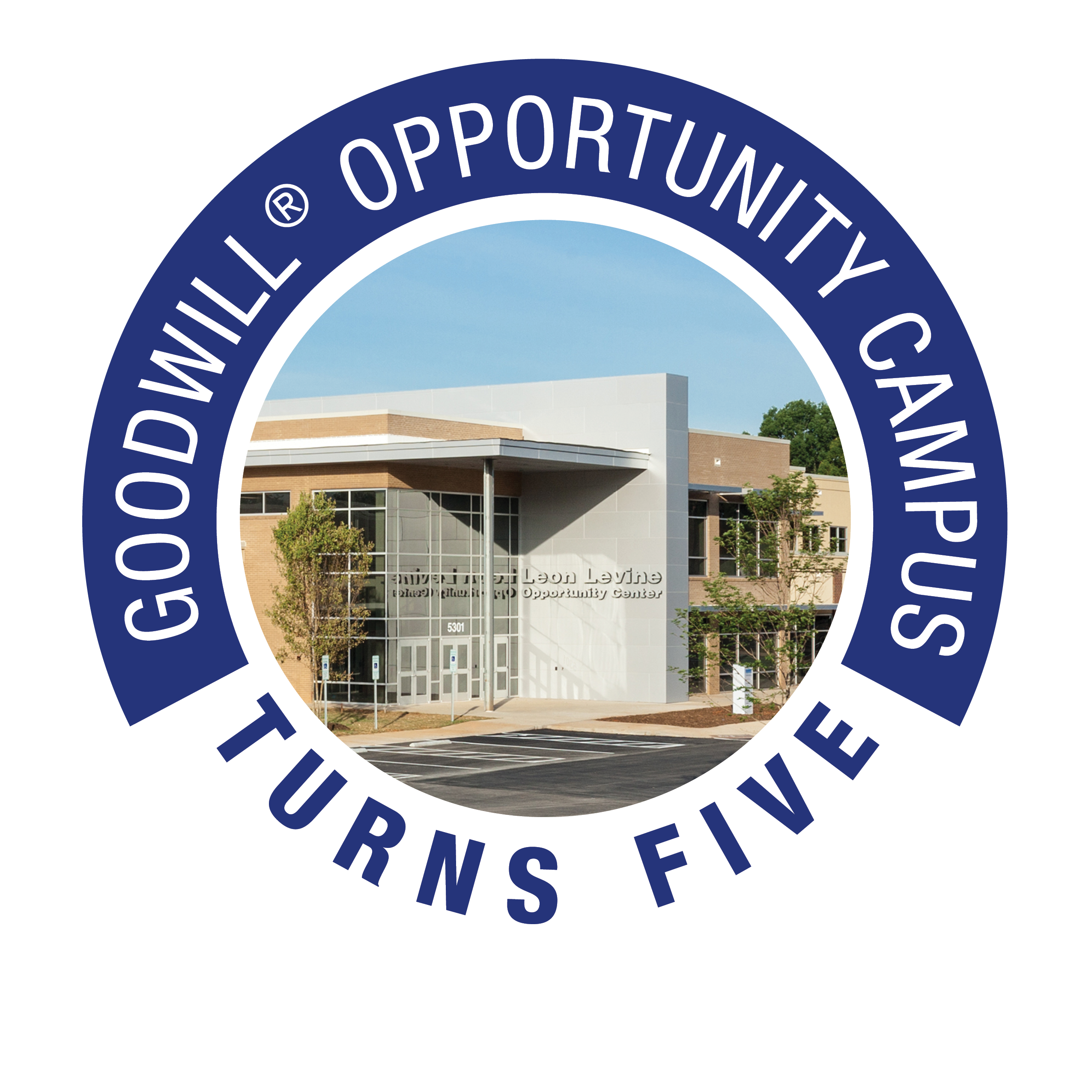
Celebrating Five Years at the Leon Levine Opportunity Center on the Goodwill Opportunity Campus
by LaRita Barber, Chief Advancement Officer
The audacity of hope is powerful thing. It took audacity to commit significant resources to a vision that would take years to be realized. But, that is exactly the courageous step that Goodwill Industries of the Southern Piedmont took as we embarked on the journey to build the Leon Levine Opportunity Center on the Goodwill Opportunity Campus. It took a village of committed team members, board members, donors and nonprofit partners to make the campus a reality.
As we pause to reflect on how far we have come since opening the doors on June 30, 2016 – the lessons learned, the lives transformed, the challenges faced and persevered, and the clarity of purpose crystalized – we are in awe of what a mustard seed of faith and hope can accomplish.
One might ask, what gave Goodwill the audacity to have such high hopes and bold ambition? What gave Goodwill the audacity to bet our future on a new way of providing services that was yet untested, that had no guarantees, and required more resources than we could supply on our own? What gave Goodwill the confidence to keep pressing forward when some state and federal legislation do not fully support our vision of opportunity and prosperity? When policies do not align with our participants’ goals to create prosperity, and the very supports that would provide stability are threatened or eliminated entirely?
What the audacity of hope has done is to embolden us to have the courage to see opportunities in our community to make a difference, to dream big, to take bold action, to take calculated risks and to have enough faith in our convictions and our mission to invest in people. While the Leon Levine Opportunity Center on the Goodwill Opportunity Campus is beautiful, it is the people that give it and us purpose. It is the people that give it a heartbeat.
Since 2016, so many people have experienced the campus. Individuals have come to take full advantage of a multitude of classes to upskill and seek better employment opportunities, meet with a coach or access technology on-site. People have visited the campus for their banking needs, to see a doctor or dentist, have a meal or cup of coffee, attend a meeting or event in our conference center, to volunteer, work in the urban garden, to shop and donate. This is exactly what we envisioned.
The campus is a source of light and hope. The work that the campus allows us to do gives us confidence to say that our work matters. It gives us a sense of pride to have others join us in this important work to partner with individuals to pursue their goals. What an honor to create a village of advocates to help propel people to a build a life that includes adequate resources to meet their basic needs, plan for the future, access meaningful career opportunities and contribute to their community. It is also a tremendous honor and responsibility to do this work.
What the audacity of hope has done is demonstrate to our community that all people matter, that justice and equity matter, and that we all share responsibility for creating a community where all can prosper. Without the audacity of hope, we would not have been able to navigate our way through the challenges of 2020. The racial and social unrest, and the pandemic, required us to hold tight to our belief in the audacity of hope to know that we had to be courageous to use our voice and do the work to shine a light on things that were not as they should be.
Since opening the Leon Levine Opportunity Center on the Goodwill Opportunity Campus five years ago, we have been blessed by so many individuals, nonprofit partners, foundations and corporations that began this journey with us, and so many others who have joined us along the way.
The $20 million investment to build the Leon Levine Opportunity Center on the Goodwill Opportunity Campus has allowed us to serve more than 45,000 individuals and create 150 new jobs at this one location. Our partners have supported so many in these five years, as well; Charlotte Community Health Clinic has been able to provide access to care for 25,000 patients and the Charlotte Metro Credit Union has created access for over 12,000 people to become banked.
The Leon Levine Opportunity Center on the Goodwill Opportunity Campus helps people see possibilities, seize opportunities and prosper. It is the realization of our audacity of hope.
By: Justin Taylor, Stakeholder Engagement Manager & Mia Comeriato, Chief Human Resources Officer
Each year, LGBTQ+ Pride Month is recognized in June. It’s an important month of recognition for the promotion of self-affirmation, dignity, equality, acceptance and increased visibility for members of the LGBTQ+ community. It’s a time to celebrate and recognize the accomplishments of the LGBTQ+ community, as well as a time to commemorate years of struggle for civil rights and the ongoing pursuit of equity.
During Pride Month, we see many companies making public gestures of support. Hundreds of major brands have become regular sponsors and supporters of annual Pride events, lending their platforms to support progress for the LGBTQ+ community.
While there are visible signs of progress, and landmark advances have been made in marriage equality and workplace protections, many challenges continue to persist in the workplace for members of the LGBTQ+ community.
As Pride Month comes to a close, it is important for us to continue the conversation and support LGBTQ+ rights year-round. It takes intentional and concerted effort to build an equitable and inclusive workplace that endures. To make meaningful progress for LGBTQ+ employees, employers can start with a few basics:
Implement policies and practices that are inclusive of LGBTQ+ issues. Employers can make health coverage inclusive of trans people; support leave for transitioning colleagues; have inclusive family leave policies; include gender-neutral restroom options in the workplace; and always ensure the use of inclusive language (such as all genders and pronouns) in policies and company communications.
Set clear expectations and stamp out inappropriate behavior. Employers can take steps to prevent and address microaggressions and depreciating behavior, starting with their leadership. They can encourage organization-wide diversity, equity and inclusion training and resources so that employees can recognize and respond to inappropriate behavior. Learning appropriate terminology can help employees understand and connect with one another.
Be intentional to make all employees feel safe and included. Employers can recognize and value openly LGBTQ+ employees at every level of the organization. They can also strengthen employee engagement by offering dedicated resources for LGBTQ+ employees. This can help ensure that potential and current employees feel safe and enjoy a sense of belonging. During the recruitment process, employers can broaden their pool of diverse candidates and adopt blind resume screening tools to reduce unconscious bias in hiring decisions.
Support career progression. Employers can actively support career progression and provide professional development opportunities for LGBTQ+ employees. This can include an effective mentorship program, career training opportunities, and awareness of broader support systems or resource groups.
At Goodwill, our purpose is to create an environment where all people can see possibilities, seize opportunities and prosper. Honoring this purpose, and creating an equitable workplace, takes all of us working together, being honest about the effects of systemic issues and other inequities experienced by members of the LGBTQ+ community, and all of us committing to real change – for the long haul. We all should be working to build an equitable and inclusive workplace year-round.
A little over 10 months ago, I shared a personal statement regarding the issues of racism and injustice in our communities – issues that have existed for a long time, but at that time, had been elevated by the tragic death of Mr. George Floyd.
Yesterday’s conviction of the ex-officer who killed Mr. Floyd is definitely a measure of justice. One that historically has not always been evident to so many in our community – in particular, those from communities of color and even more specifically, Black communities
I hope all that has happened in the past year, including yesterday’s conviction, is a catalyst for the change we need to see in holding people accountable for their actions, which leads to justice, and hopefully restoration. Most importantly, this is an opportunity for us to drive out the ignorance and hate that continues to plague our communities.
We must shine a light on the policies, implicit bias and silent voices that continue to stifle opportunity and access. We must face head on and dismantle the systems that provide fertile soil for these injustices to thrive and grow deeper roots. In the words of James Baldwin, “not everything that is faced can be changed, but nothing can be changed until it is faced.”
In my communication from last year, I talked about how strongly the ideals of diversity, equity, inclusion, and justice are connected to our purpose at Goodwill Industries of the Southern Piedmont. I shared that while there is no certainty in life, there is commitment, and we can each commit to being better and doing better.
Our shared purpose, “to help people see possibilities, seize opportunities, and prosper,” is about commitment.
A commitment to partner with individuals and families who are working hard to achieve their goals and achieve prosperity. A commitment to partner with them in a way that promotes dignity and builds on the inherent strengths everyone possesses. A commitment to serve others with excellence regardless of their background, circumstance, or color of their skin.
We commit ourselves every day to ensure Goodwill is a welcoming and inclusive place to shop, donate, receive services, and especially, to work. We want everyone to have a sense of belonging. We are here for you – and you have a place here.
Lastly, I want to reiterate my personal commitment to continue to lead this organization in a way that upholds and elevates our shared purpose. That encourages and supports positive dialogue around issues of equity and justice and promotes action that creates positive change in our organization, community, and country.
Sincerely,

Chris Jackson
President & CEO
In April, we recognize Second Chance Month, a time to raise awareness of the challenges facing people with justice-involved backgrounds and to spotlight the important work being done by community-based organizations to empower second chance individuals to achieve career and life success.
Did you know that more than 600,000 individuals are released from state and federal prisons every year in the United States? To prepare for successful reentry into their communities, they need tools and resources to overcome obstacles to employment, housing and social activities.
This is why Goodwill Industries of the Southern Piedmont partners with The Center for Community Transitions (CCT), an organization that helps justice-involved individuals and their families with employment and reentry services. We help to connect Goodwill participants with justice-involved backgrounds to CCT to take advantage of their specialized supports, and help to enroll CCT participants into job training programs at Goodwill. Together, we help to reduce recidivism by providing people with criminal records and their families tools and resources to rebuild their lives.
CCT’s LifeWorks! Program, focused on employment readiness, is based at the Goodwill Opportunity Campus, which helps foster the relationship between the two organizations and to provide a better experience for participants. Together, we offer individuals opportunities to engage in learning, skills development, work experience and holistic reintegration services.
Here at Goodwill, we know that the real work involves addressing the public policies and systemic practices that can contribute to a lack of access to opportunity. We seek to advance policy solutions that help people impacted by the justice system have a second chance for success and a fair chance for employment. Former offenders seeking jobs are only successful if companies are willing to look beyond their criminal record and implement proactive and well-informed employment practices. That’s why we advocate for second-chance employment and are proud to hire formerly incarcerated individuals.
By investing in community-based reentry programs, providing greater access to pre- and post-release education and training, promoting fair-chance hiring practices, removing barriers to employment and occupational licensing, and addressing the collateral consequences of conviction, second-chance individuals can change their lives through learning and the power of work!
We encourage you to read James Shepherd’s story. After spending four years in prison for a crime he didn’t commit, James finally had his conviction overturned and was looking to get his life back on track. He was able to enroll in Goodwill’s construction skills training program and launch into a new career!
How the COVID-19 pandemic impacts the digital divide and what can we do to address it.
By Dr. Dana McDonald, VP of Talent Development, Goodwill Industries of the Southern Piedmont
COVID-19 and the subsequent Stay-at-Home orders, working and schooling from home and social distancing have highlighted many of the disparities that exist in our world. The digital divide is yet another story of “haves and have nots.” It is the gulf between those who have access to devices and the internet, and those who do not, and today it’s affecting their ability to prosper more than ever before. Even if you have access to technology, access to reliable broadband internet impacts our quality of life in many areas — delivery of health care, education, access to information and, not least of all, employment and economic opportunity. The COVID-19 pandemic has made the digital divide a critical issue directly linked to finding, securing and maintaining a job – and quality of life.
Imagine your day and the challenges created when you do not have consistent, reliable, quality access to broadband internet or devices to use the internet. Just as there are “food deserts,” many of our neighbors are living in “broadband deserts.” According to Digital Charlotte, in 2017 almost 5,000 households in Mecklenburg County had no internet access at all or didn’t have the means to purchase it in the future. That’s nearly 20% of the county’s population. Unfortunately, these deserts are often in communities of color, and in areas that experience economic inequities such as income and education. Over the past three years, participant data suggests there is approximately a 35% chance that a person served by Goodwill will not have broadband internet access. This issue is not contained to rural areas, but also urban and suburban areas. Data from the Federal Communications Commission reveals that percentages of people and businesses in south Charlotte often have access to broadband at rates three times higher than the rest of the city.
At the most basic level, digital access is the “ticket” to the game called work. In fact, according to Digital Charlotte, 80 percent of job opportunities are posted exclusively online. Then in order to earn most jobs and to do the work, basic digital skills are needed. Digital skills are definitely required to advance to higher-paying jobs, often referred to as middle skill jobs. At Goodwill, we focus on helping people advance their careers and improve their circumstances. That’s why we offer digital skills training at all levels – from basic computer use to productivity skills like Microsoft Word or Excel, to advanced training that leads to IT-related careers.
Equitable access to technology and skills directly impacts equitable access to jobs and, in particular, jobs that can sustain a family. It’s important to note that COVID-19 did not cause issues around digital equity and job equity. But it has highlighted and exacerbated the gaps in our communities that people, especially people of color, are likely to slip through. With today’s “new normal” the digital divide has become a chasm that is nearly impossible for many to cross. “Stay at home” for many means “work from home,” which requires quality broadband access, a computer, and digital skills. For those without digital access or in jobs with lower digital requirements the alternatives include leaving home to work or losing your income because your employer has closed. These are decisions people are making daily that impact safety, public health and quality of life for entire families and communities.
Because of these difficult decisions, Goodwill is serving more than 1,000 people per week to provide access to basic needs, job search support and career training. But without access to quality broadband and internet-connected devices, all of our participants aren’t able to take advantage of career-enhancing digital skills training courses, research available community resources, or conduct thorough job searches.
Given the amplified issues we now face in the era of COVID-19, we must focus energy, resources and innovative thinking to find solutions that provide quality and affordable access to broadband and devices to all communities. We’re taking action to address the digital divide. Goodwill plans to provide laptops and WiFi hotspots to people we serve who need these devices to advance their careers and sustain their families – but we need your help. With the community’s support, we hope to raise enough funds to provide laptops and hotspots to give to people who are accessing our services to improve their careers and their lives. Can you help us close the gap? What action can you take to address the digital inequities in our community?
A Letter from Chris Jackson, President & CEO, Goodwill Industries of the Southern Piedmont
This is an almost indescribable time in our history. There are moments in time when there are just no words to describe the pain, loss, hurt and injustice that we are experiencing nationally and locally. A global pandemic is causing so many lives and livelihoods to be lost, and the tragic and inexcusable death of Mr. George Floyd is elevating once again the systemic issues of race, equity, and justice in our country.
There is so much tragedy around us that it can be overwhelming and hard to know what to do. I understand this feeling and personally fight against it every day. Inaction is part of the problem, so I choose to focus on educating when I see ignorance, calling out injustice and inequity when I see it, and using the areas that I can influence to create positive change.
There is no absolute certainty in life, but there is commitment. We can each commit to being better and doing better. The shared purpose of Goodwill Industries of the Southern Piedmont to help people see possibilities, seize opportunities, and prosper is about commitment. A commitment to partner with individuals and families who are working hard to achieve their goals and to prosper. A commitment to partner with them in a way that promotes dignity and builds on the inherent strengths everyone possesses. A commitment to serve others with excellence regardless of their background, circumstance, the color of their skin, sexual orientation, gender expression or however they identify. This is our work and has been for over 50 years.
But, this work is getting harder. And, we must shine a light on the reasons why. We must shine a light on the policies, implicit bias and silent voices that continue to stifle opportunity and access. We must face head on and dismantle the systems that provide fertile soil for these injustices to thrive and grow deeper roots. In the words of James Baldwin, “not everything that is faced can be changed, but nothing can be changed until it is faced.”
The egregious acts, voices and images that we have experienced, heard and witnessed make it impossible to ignore what must be faced. Everyone must commit to doing their part and not underestimate their power to influence change.
As President & CEO of Goodwill Industries of the Southern Piedmont, I commit to continue to lead this organization in a way that upholds and elevates our shared purpose. I commit to encourage and support positive dialogue around issues of equity and justice and to promote action that creates positive change in our organization, community, and country. No one can do this work alone, so I invited team members in our organization to make their own personal commitments to be the change they want to see. Below are some examples from members of our management team:
“I commit to providing a space and a platform for conversation around issues of inequality and other topics that may feel uncomfortable. I understand, although with the best of intentions, being silent and not acknowledging the current events and inequities surrounding us is not going to create positive change. I commit to supporting my community – but especially my colleagues – to ensure their health and safety by asking curious questions, learning more, understanding more and reaching out to ensure their well-being even if I don’t have the right or most buttoned-up words to acknowledge their circumstances and realities.”
“I commit to paying attention to, and taking action to address, injustices that don’t directly affect me personally just as passionately as those that do. I commit to shining a light on micro-aggressions and language or actions that are hurtful to others – no matter who they come from. I commit to educating myself and setting an example of showing love, kindness and respect to all those around me – and especially those who look, think or act differently than me – so my daughter can see what it means to be an ally, an advocate and an inclusive member of society. I commit to teaching my child about our country’s history, about the oppression and injustice that has occurred and continues to occur, and about how to love and respect all people. I commit to raising my child to have the courage to stand up to injustices when she sees them, too, so she can be part of the change her generation can make in our world.”
“I commit to listen, learn, and to develop a better understanding of the racial bias and injustice that has happened and continues to happen in today’s society. To be a voice and call out injustice and to participate in activities that can further help and heal our community and society. To be humble and compassionate when people are hurting and provide support that can provide positive healing.”
Change cannot happen when people are silent and paralyzed to act. Justice will not be served until those who are unaffected are as outraged as those who are. – Benjamin Franklin
What can you commit to doing to make our community the best it can be for all people? I invite you to share your personal commitment to support positive dialogue around issues of equity and justice and to promote action that creates positive change.
All The Best,
Chris Jackson
President & CEO, Goodwill Industries of the Southern Piedmont
By Chris Jackson, President & CEO of Goodwill Industries of the Southern Piedmont
As businesses across our region are experiencing extended closures due to the spread of COVID-19, many of our neighbors, friends, and family members are experiencing crippling financial impacts.
As the leader of an organization committed to helping people prosper, I like many other leaders am finding a steep new set of challenges as a result of this pandemic. And like many other leaders, I am committed to deliver on Goodwill’s promise to the community, regardless of circumstances.
Goodwill continues to focus heavily on supporting our team members, our clients, our customers, and our community. With significant constrictions on budgets, we like many, have had to make some tough decisions. We are also finding that the economic impact of the crisis is making deeper community challenges more visible.
On March 26, we closed all of our retail stores and other parts of our business based on the stay-at-home orders for our region. We made the extremely difficult decision to temporarily lay off more than 750 team members while also supporting those working virtually so we could continue to provide access to training and employment services for people in our community, as they need now them more than ever.
It is no secret that the Charlotte region struggles with upward mobility for all of its residents. COVID-19 has amplified this and is disproportionately impacting people with limited resources, options, and access. While the coronavirus doesn’t discriminate, data indicates that people of color and low-income families are bearing the brunt of this pandemic. In short, the impact is reflecting the racial and socioeconomic disparities that exist in our community.
Individuals in traditionally low-wage jobs are less likely to have health insurance and potentially lack paid time off. Layoffs are affecting workers in positions related to food and hospitality services, retail, and more. Unemployment claims have skyrocketed to an historic level. (As of April 17, the North Carolina Division of Employment Security reported receiving more than 630,000 claims for unemployment benefits, with most of them related to COVID-19.)
While these burdens may be unprecedented – they do not have to be insurmountable.
We must be creative and engage differently to support those whose lives have been upended and increasingly uncertain. We must continue to support those already struggling to make ends meet to sustain themselves and their families.
I find myself reflecting on two key questions, and offer them to you to consider:
- How can we continue to find creative solutions to create opportunity during this pandemic, and in its aftermath?
- How do we continue to make progress for those facing the most challenging situations?
I have concluded that first – we can focus on what we can control, starting with our own organizations. Our teams are depending on us to do everything we can to ensure a safe and healthy work environment and to support them in sustaining their families.
Work to ensure an environment that creates access and removes obstacles. Allow flexibility in your policies to help team members navigate challenges. Wherever possible allow for remote working. Provide as much support as possible and be cognizant of and address the challenges that some may have if they don’t have the resources they need. Ensure equitable access to technology. Be mindful that individuals working from home are juggling challenging and stressful circumstances with children and other caregiving responsibilities.
Communicate, communicate, and communicate. Share the guiding principles you are using to make decisions, share with clarity what you know for sure, and be honest about what you don’t know yet. Stay connected, and encourage, support, and model self-care.
Don’t lose sight of the future. While we focus on getting through this healthcare crisis, we also need to continue to focus on the long-term needs of equitable access to opportunities and economic mobility. Create forums to discuss what will be necessary as we get on the other side of the pandemic. Focus on key questions about how we will need to work differently to ensure the best outcomes for individuals and families, and how to do so in the most collaborative and innovative way possible.
Commit to continuing this creative and collaborative momentum! Now is the time when we can step up to provide leadership in uncertainty, and to pave the way for supporting our communities for the long-term – together. We can each demonstrate leadership by working together and taking care of one another, both now and when the stay-at-home orders are lifted. I’m excited to see so many organizations leading the charge to address issues like food insecurity and inequities in internet access. I applaud businesses that have been on the cutting edge of providing relief to people experiencing financial challenges. Our call is to ensure this care and consideration continues in the days, weeks, and years to come.
As many others are leading the charge to make sure the Charlotte region is the caring community so many people desperately need, we intend to be a guiding light in this season of uncertainty. Goodwill exists to help people see possibilities, seize opportunities, and prosper. Our commitment is to stand by and with the people who need us most during this critical time. Our work is partnering with people in our community to help them achieve their goals around family-sustaining employment – this means accessing jobs that provide better wages, benefits that support their families, and opportunities to develop to build a career.
This is indeed a challenging time for all of us. I pray that as a community we will work together to get through it and in doing so, will gain some empowering lessons that will make us better.
This year, responding to the Census is easier than ever. You can respond online, by phone or by mailing in a printed form.
According to the U.S. Census Bureau, about 64 million households across the nation are receiving a paper questionnaire in the coming days. If you or someone you know doesn’t receive a letter in the mail, the Census Bureau will drop off a Census invitation and paper form as soon as it is safe to do so. Census takers will also follow up with all households that do not respond on their own.
You can choose to respond online at 2020census.gov in English or 12 other languages, or receive assistance through language guides and videos available in 59 languages. Of the nation’s households, 46.2% have already responded to the 2020 Census. The remaining households will receive a paper questionnaire starting April 8.
If you are still skeptical about what will be asked or what the information will be used for, click here to get the facts. The Census data is critical for funding our future needs. Respond and take it today! Your input will make a significant difference and will directly impact the funding for our future.
Voting is Important for a Healthy Democracy
Election season is right around the corner, and it’s an important time to have our voices heard. Voting is the way citizens have a voice on the issues that are important to them, and it’s vital for a healthy democracy. While we’re waiting for next year’s presidential election, we must vote during our state and local elections. The legislation passed at the state and local level has more of a direct and immediate impact on our daily lives. It allows us to have our voices heard and elect people who best represent us!
Find Out Your Voter Registration Status
We know voting is necessary for our democratic process, and knowing if you’re registered to vote is an essential step in the process.
Most states have a voter registration look-up tool you can use online. There, you can check your registration status, see where you can vote and who your local, state and federal representatives are. If you reside in either North Carolina or South Carolina, you can check out your voter registration status by clicking the links below.
Who Can Register to Vote?
In order to register to vote, every person must meet the following qualifications:
- Must be a citizen of the United States.
- Must live in the county of their registration and have resided there for at least 30 days before the date of the election.
- Must be at least 18 years old. A prospective voter can submit a registration form up to two years before their 18th birthday, if and only if they will be 18 at the time of the next general election.
- Must not be serving a sentence for a felony conviction (including probation or parole). If a prospective voter has previously been convicted of a felony, their citizenship rights must be restored.
Moved Recently? Make Sure to Update Your Registration in Time
It is important to note if you have moved recently, you must make sure to update your registration. This can impede one’s ability to vote in upcoming elections. Depending on the state rules and regulations, voter registration applications must be submitted at least 30 days before the election in which the prospective voter wants to vote. The registration deadline for North Carolina is October 5, 2019, and the registration deadline for South Carolina is October 6, 2019.
Special Circumstance: Voting Rights for People with Criminal Backgrounds
People with criminal backgrounds may face obstacles exercising their right to vote. People convicted of a felony are ineligible to vote while in prison, on parole or probation. A person’s voting rights are automatically restored upon completion of all supervised release. We encourage people with criminal backgrounds to update their voter registration status.
Special Circumstance: Voting and Homelessness
People experiencing homelessness or who are otherwise in housing transition face special challenges when registering to vote. People experiencing homelessness can register and vote in all 50 states. It is recommended registrants who are homeless list a shelter address as their voting address where they could receive mail. Alternatively, registrants who are homeless may designate a street corner or a park as their residence, instead of a traditional home address. The federal voter registration form and many state forms provide a space for this purpose. Remember, the best source of information about these issues is your state or county election officials.
Special Circumstance: Voting and Domestic Violence
Address Confidentiality Programs (ACP) and Confidential Voter Listings are programs administered by the state that enable survivors of domestic violence to vote without fear of being found by their abusers by providing a substitute address for all public records. Confidential Voter Listings only provide confidentiality on election-related public records. The National Network to End Domestic Violence provides a list of currently available programs. For more information on ACPs and Confidential Voter Listings in your state, contact your local election officials.
Special Circumstance: Voting with a Disability
Visit these links for information related to voting with disabilities from national organizations.
- Disability Vote Project: American Association of People with Disabilities
- Disability and Voter Turnout – Reports and fact sheets on voter turnout by people with disabilities
- National Disability Rights Network – Election Center 2016
- National Council on Disability – “Experience of Voters with Disabilities in the 2012 Election Cycle,” October 2013
Every year millions of Americans are unable to vote because they missed a registration deadline, don’t update their registration or don’t know how to register. Hopefully, this voter resources guide provided all the necessary information you need to know about how to vote in this upcoming election season!
For additional resources about voter registration and voting in general, visit Nonprofit VOTE or Vote411.
Help us spread the word and get people registered to vote by sharing this guide!
Recently, Superior Court Judge G. Bryan Collins Jr. struck down two of the four constitutional amendments that North Carolina voters passed in November – the voter ID amendment that required voters to show identification and the income tax cap that was designed to cap the state’s income-tax rate at 7 percent.
Collins’s ruling was made due to concerns about gerrymandering, a strategy used to divide a territory into election districts in a way that intentionally gives one political party an unfair advantage. Collins noted: “Whether an unconstitutionally racially-gerrymandered General Assembly can place constitutional amendments onto the ballot for public ratification is a justiciable issue and not a political question.”
In our community there are many who would have been negatively impacted by the approval of these amendments. The voter ID amendment in particular would have significantly impacted voter turnout among the elderly, the disabled and minorities. The American Civil Liberties Union (ACLU) notes many reasons not to implement voter ID laws and/or requirements. To view these reasons, click here.
The NC income tax cap would have a variety of negative impacts that would directly effect low-income families and individuals. The Raleigh News & Observer illustrated the challenges in an article published back in July of 2018. The article specifically states, “Sales taxes (and usage fees) impact poor people much more than they impact wealthy people: Poor people must spend most of their income, subjecting most of their income to sales tax, while wealthier people spend a much lower percentage of their income.” To read more, click here.
Neither of these amendments reflects fairness, equal rights or values related to supporting economic mobility. As we strive to better support individuals and families in our community, it is imperative that we stay abreast of public policies. The changes being recommended and made make a difference!